Logistics
|
5
min read

Beyond the Dashboard: Systems as the True Source of Insight in Manufacturing and Logistics

Why traditional dashboards fall short in complex operational environments and how integrated systems transform data into actionable understanding

The Aethriom Team
Aethriom
Published
February 3, 2026
February 3, 2026
Logistics
5
min read

Beyond the Dashboard: Systems as the True Source of Insight in Manufacturing and Logistics

Why traditional dashboards fall short in complex operational environments and how integrated systems transform data into actionable understanding

Aethriom
Published
February 3, 2026
Artificial Intelligence
Manufacturing
Logistics

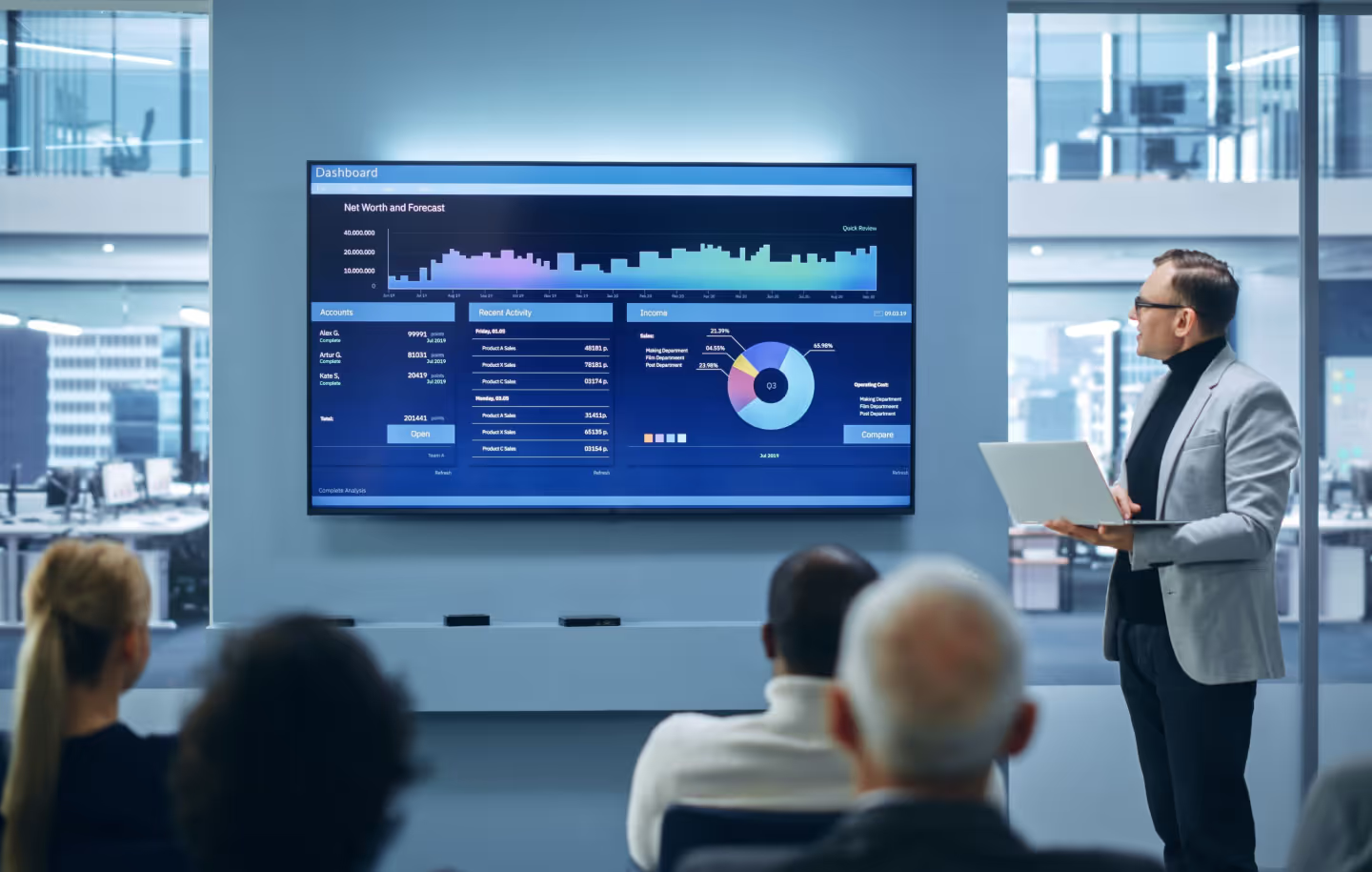
In the control room: An operator confronts a sudden production delay revealed only after the fact

A wall-mounted screen glows in an otherwise subdued control room. An operator scans the latest production statistics, the dashboard's charts and alerts ticking over with the data stream. The numbers have slipped - key equipment has underperformed for nearly an hour. A red notification blinks, signaling a disruption in the manufacturing line. Yet, by the time the operator notices, the delay has already rippled through subsequent processes. Orders are behind, and a critical shipment now risks missing its window. With no immediate clues as to why, the operator is left to piece together a fragmented narrative from multiple dashboards, each drawing on data from different systems - ERP, WMS, machine sensors. The real question - what triggered the disruption, and could it have been anticipated rather than discovered only after the fact - remains unresolved.

The dashboard dilemma: Fragmented data and retrospective views

Manufacturing dashboards have become fixtures in industry command centers, offering condensed, visual representations of complex operations. Yet these tools typically rely on aggregating information from disparate systems: Enterprise Resource Planning (ERP) modules reveal inventory movements, Warehouse Management Systems (WMS) capture goods flows, Transportation Management Systems (TMS) monitor shipments, and Industrial IoT networks feed streams of sensor data. Despite their apparent integration, these sources often update at different rhythms or communicate only through brittle interfaces. The result is a retrospective snapshot - data that reveal what happened, sometimes with significant lag, without illuminating underlying causes. Periodic updates may obscure rapid or cascading disruptions, while differences in data granularity and timing breed inconsistencies. Dashboard visualizations excel at displaying historical facts, but rarely, on their own, do they surface the causal chains or subtle signals leading up to an event. The complexity of modern manufacturing and logistics environments outpaces the static, descriptive power of even the most sophisticated dashboards.

Human perspective: The operators and managers caught between data and decision-making

Operators and managers at the sharp end of manufacturing and logistics face an acute dilemma. When disruptions surface - be it a late shipment, a bottleneck in assembly, or unexplained equipment downtime - they must sift through a dense field of data fragments. With dashboards presenting static summaries, much of the interpretive work falls to individual expertise. Some [operations managers] describe a recurring cycle: reacting to events only after impact, assembling ad-hoc cross-team investigations to discover root causes, and struggling to correlate patterns across departmental silos. In the absence of predictive insight, corrective actions are often delayed or based on partial information. The pressure to maintain service levels and meet tight schedules heightens the cost of each blind spot. Despite growing investments in digital reporting, many decision-makers still find themselves responding to yesterday's events with little warning about what may unfold next.

Expert insight: The case for integrated systems and AI-driven forecasting

A growing body of technical experts in operational intelligence argues that genuinely actionable insight comes from interconnected systems, not visualizations. By consolidating data pipelines across transactional, sensor, and external feeds, these integrated platforms create a continuous real-time view of manufacturing flows. Advanced tools - particularly those leveraging generative AI - now analyze not just what happened but what may happen next. For example, AI-driven demand forecasting synthesizes current and historical sales, market trends, and even weather projections to predict order surges or supply risks. In production planning, algorithms generate dynamic schedules that respond to shifts in resource availability or customer priorities. In logistics, AI models recalculate optimal routes on the fly, considering live data on traffic, weather, and unexpected disruptions. Rather than simply reporting on events, these systems propose responses to emerging scenarios - offering not retrospective dashboards, but decision-ready insight. Companies like Aethriom, for instance, have positioned themselves at this intersection, developing platforms to merge traceability data and strategic execution. However, the sophistication of these systems demands rigorous data architecture, extensive integration, and continuous oversight. Some deployments reveal limitations: AI recommendations can falter when data inputs are delayed, when on-the-ground realities diverge from digital models, or when system complexity reduces transparency for users.

At the frontier: Navigating uncertainty in evolving operational intelligence

While advances in integrated systems and AI forecasting are reshaping expectations, the path forward carries unresolved tensions. Operational contexts remain dynamic and deeply variable - what works in a high-volume automotive plant may falter in pharmaceuticals or bespoke manufacturing. New vulnerabilities emerge when dependence on automation outpaces organizational readiness or when system failures propagate more rapidly through tightly coupled networks. Human operators, meanwhile, continue to play a critical interpretive role, especially as systems surface anomalies that defy easy explanation. For technology leaders, the challenge lies not just in building more connected and predictive architectures, but in shaping organizations that adapt alongside them. As the limits of manufacturing dashboards become clearer, questions about how best to balance automated insight with situational awareness, anticipation with resilience, and system-driven foresight with human judgment remain open - and the solutions will likely continue to evolve alongside the operational landscape they aim to illuminate.

Conclusion

The challenges highlighted in this article underscore a fundamental reality: dashboards alone, with their fragmented, lagging, and static views, cannot fully deliver the insight manufacturing and logistics leaders need to anticipate and respond to disruptions. Instead, integrated operational intelligence systems that unify data streams, provide live traceability, and enable AI-driven forecasting offer a more grounded path to understanding what happened and what may come next. Aethriom’s CIPHER™ platform exemplifies this approach by creating a single, trustworthy record of truth across materials, processes, and quality events - helping reduce ambiguity and support human oversight. By focusing on real-time lineage and strategic execution, such systems make it easier for organizations to balance automated foresight with the critical judgment of their operators, enabling clearer visibility into complex operations and timely, confident decisions. This combination of technology and human insight is essential for navigating the evolving uncertainties of modern manufacturing and logistics environments.
Artificial Intelligence
Manufacturing
Logistics

In the control room: An operator confronts a sudden production delay revealed only after the fact

A wall-mounted screen glows in an otherwise subdued control room. An operator scans the latest production statistics, the dashboard's charts and alerts ticking over with the data stream. The numbers have slipped - key equipment has underperformed for nearly an hour. A red notification blinks, signaling a disruption in the manufacturing line. Yet, by the time the operator notices, the delay has already rippled through subsequent processes. Orders are behind, and a critical shipment now risks missing its window. With no immediate clues as to why, the operator is left to piece together a fragmented narrative from multiple dashboards, each drawing on data from different systems - ERP, WMS, machine sensors. The real question - what triggered the disruption, and could it have been anticipated rather than discovered only after the fact - remains unresolved.

The dashboard dilemma: Fragmented data and retrospective views

Manufacturing dashboards have become fixtures in industry command centers, offering condensed, visual representations of complex operations. Yet these tools typically rely on aggregating information from disparate systems: Enterprise Resource Planning (ERP) modules reveal inventory movements, Warehouse Management Systems (WMS) capture goods flows, Transportation Management Systems (TMS) monitor shipments, and Industrial IoT networks feed streams of sensor data. Despite their apparent integration, these sources often update at different rhythms or communicate only through brittle interfaces. The result is a retrospective snapshot - data that reveal what happened, sometimes with significant lag, without illuminating underlying causes. Periodic updates may obscure rapid or cascading disruptions, while differences in data granularity and timing breed inconsistencies. Dashboard visualizations excel at displaying historical facts, but rarely, on their own, do they surface the causal chains or subtle signals leading up to an event. The complexity of modern manufacturing and logistics environments outpaces the static, descriptive power of even the most sophisticated dashboards.

Human perspective: The operators and managers caught between data and decision-making

Operators and managers at the sharp end of manufacturing and logistics face an acute dilemma. When disruptions surface - be it a late shipment, a bottleneck in assembly, or unexplained equipment downtime - they must sift through a dense field of data fragments. With dashboards presenting static summaries, much of the interpretive work falls to individual expertise. Some [operations managers] describe a recurring cycle: reacting to events only after impact, assembling ad-hoc cross-team investigations to discover root causes, and struggling to correlate patterns across departmental silos. In the absence of predictive insight, corrective actions are often delayed or based on partial information. The pressure to maintain service levels and meet tight schedules heightens the cost of each blind spot. Despite growing investments in digital reporting, many decision-makers still find themselves responding to yesterday's events with little warning about what may unfold next.

Expert insight: The case for integrated systems and AI-driven forecasting

A growing body of technical experts in operational intelligence argues that genuinely actionable insight comes from interconnected systems, not visualizations. By consolidating data pipelines across transactional, sensor, and external feeds, these integrated platforms create a continuous real-time view of manufacturing flows. Advanced tools - particularly those leveraging generative AI - now analyze not just what happened but what may happen next. For example, AI-driven demand forecasting synthesizes current and historical sales, market trends, and even weather projections to predict order surges or supply risks. In production planning, algorithms generate dynamic schedules that respond to shifts in resource availability or customer priorities. In logistics, AI models recalculate optimal routes on the fly, considering live data on traffic, weather, and unexpected disruptions. Rather than simply reporting on events, these systems propose responses to emerging scenarios - offering not retrospective dashboards, but decision-ready insight. Companies like Aethriom, for instance, have positioned themselves at this intersection, developing platforms to merge traceability data and strategic execution. However, the sophistication of these systems demands rigorous data architecture, extensive integration, and continuous oversight. Some deployments reveal limitations: AI recommendations can falter when data inputs are delayed, when on-the-ground realities diverge from digital models, or when system complexity reduces transparency for users.

At the frontier: Navigating uncertainty in evolving operational intelligence

While advances in integrated systems and AI forecasting are reshaping expectations, the path forward carries unresolved tensions. Operational contexts remain dynamic and deeply variable - what works in a high-volume automotive plant may falter in pharmaceuticals or bespoke manufacturing. New vulnerabilities emerge when dependence on automation outpaces organizational readiness or when system failures propagate more rapidly through tightly coupled networks. Human operators, meanwhile, continue to play a critical interpretive role, especially as systems surface anomalies that defy easy explanation. For technology leaders, the challenge lies not just in building more connected and predictive architectures, but in shaping organizations that adapt alongside them. As the limits of manufacturing dashboards become clearer, questions about how best to balance automated insight with situational awareness, anticipation with resilience, and system-driven foresight with human judgment remain open - and the solutions will likely continue to evolve alongside the operational landscape they aim to illuminate.

Explore Integrated Operational Intelligence

Discover how Aethriom’s CIPHER™ platform can help unify your data and transform complexity into clear, actionable insight for modern manufacturing and logistics challenges.